Loyola University New Orleans practicums in Louisiana
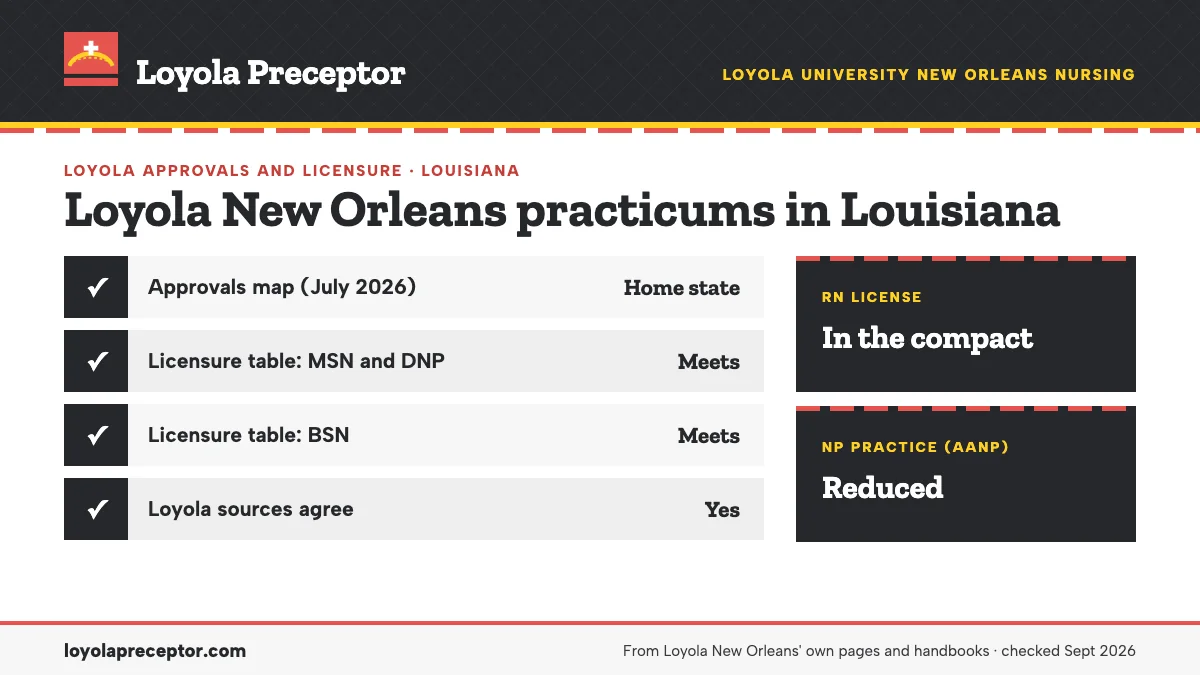
Louisiana is home to Loyola University New Orleans, and every Loyola state source clears it for every nursing program. What shapes a Louisiana practicum is state law and health system policy: the Louisiana State Board of Nursing's preceptor rule, the collaborative practice agreement behind every NP preceptor who diagnoses and prescribes, and the affiliation rules each system publishes. This guide takes each in turn, then the parishes where care runs short and the road to a Louisiana APRN license.
Get your placement plan
Tell us your Loyola program and where you live. A placement advisor replies with the preceptor and site options that fit your Loyola course.
Every Loyola source clears Louisiana
Louisiana is the one state where Loyola speaks without qualification. Its professional licensure disclosures page says every Loyola licensure-track program meets Louisiana's educational requirements, and the School of Nursing states that all of its programs carry approval from the Louisiana State Board of Nursing (LSBN). Loyola's documents line up for Louisiana:
| Loyola source | Date | Result for Louisiana |
|---|---|---|
| Advanced practice (MSN and DNP) licensure table | June 2, 2026 | Meets educational requirements, no note |
| BSN (pre-licensure) licensure table | June 2, 2026 | Meets, no note |
| School of Nursing State Approvals Map | July 15, 2026 | Approved for all programs (green) |
| Earlier approvals map, still linked | August 20, 2025 | Approved for all programs (green) |
Home-state status also removes a step. LSBN's rule for out-of-state programs (LAC 46:XLVII.3539) makes them seek board approval at least six months before placing students in Louisiana. Loyola, a Louisiana school, sits outside that rule. The licensure disclosures guide compares Loyola's sources for every other state.
Collaborative practice: the framework your NP preceptor works in
AANP classes Louisiana as a reduced-practice state. Under LSBN's rule LAC 46:XLVII.4513, an APRN who stays within the nursing scope needs no collaborative practice agreement (CPA), but one who makes medical diagnoses and manages treatment must have one. The CPA spells out how a collaborating physician or dentist stays available for consultation and referral, the practice methods and guidelines the APRN follows, and who covers during absences.
Prescribing adds more to the agreement. Clinical practice guidelines list the drug types or schedules allowed, are specific to the site, are kept there, and are signed at least yearly. A site may name no more than two collaborating physicians, plus an optional designated alternate under a written organizational policy. Schedules II to V are authorized one practice at a time, within the physician's specialty, and need a Louisiana CDS license and DEA registration.
The upshot for you: prescribing at a Louisiana site follows that site's own guidelines, so two NPs in the same specialty can work under different limits. The Louisiana APRN practice guide follows these rules into the question of who can precept you.
The LSBN preceptor rule, point by point
LSBN's preceptorship rule, LAC 46:XLVII.3543, binds every Louisiana nursing program, Loyola included. Any preceptor you bring forward for a Louisiana site is measured against it:
- Faculty keep responsibility for selecting and guiding your learning experiences and for evaluating you, with input from the preceptor.
- Preceptors are chosen by written criteria that faculty and the facility's nursing administration draw up together.
- A faculty member stays reachable by the preceptor and confers with each preceptor and student at least weekly.
- Each faculty member oversees nine APRN preceptorship students at most, and each preceptor takes at most two graduate APRN students within one clinical experience.
- Every preceptor holds an active, unencumbered Louisiana RN and/or APRN license.
- Most graduate clinical time is spent with an APRN preceptor licensed and certified in your population focus; other clinicians can add interprofessional experience.
The last point shapes FNP searches. Loyola's FNP guide allows FPCM I and II to run under an NP, a physician or a PA, while LSBN wants the majority of graduate time with an APRN in your population focus, so a Louisiana plan leans on family NPs across the four courses. A companion rule, LAC 46:XLVII.3529, has programs secure board approval of each clinical agency through a clinical facility survey at least four weeks before use. No Louisiana rule assigns the preceptor search to either the school or the student.
Ask a Louisiana preceptor how many graduate APRN students they already supervise: at two, LSBN's rule leaves no room for you in that clinical experience.
What Louisiana health systems ask of schools
Several Louisiana systems post rules for graduate nursing students, and each puts the school, not the student, at the center of the request:
| System | What its own pages say |
|---|---|
| Ochsner LSU Health (North Louisiana) | Since April 1, 2024, graduate nursing requests, placement and compliance run through InPlace, entered only by the school's faculty or coordinator; students have no InPlace access. It requires an active academic affiliation agreement, an RN license for the clinical's state or a compact license, and LSBN approval for APRN clinicals. Requests are due at least three months ahead. |
| CHRISTUS Health | Offers rotations for advanced practice practitioners. A written, signed Clinical Education Affiliation Agreement must be complete before the placement term, and the student's faculty advisor identifies a CHRISTUS site and contacts the academic office. Placements are not assured. |
| LCMC Health (UMC New Orleans, Touro, East Jefferson, West Jefferson) | LCMC Health's learner page says every learner needs a current academic affiliation agreement between the school and LCMC. Academic Affairs does not match preceptors; once the agreement is confirmed, learners work through their school's preceptorship coordinator and the facility's education office. |
| Ochsner Health (New Orleans) | Its nursing clinicals pages describe undergraduate clinicals with RN preceptors and the Ochsner Scholars tuition program. |
Ochsner LSU Health adds that students should not call its providers, that its academics team confirms each preceptor, and that its own employees and highly rated programs come first in line. Loyola's own Ochsner tie is undergraduate: BSN students rotate through Ochsner Health, which Loyola names as its partner. For graduate students, every system puts the agreement first, so Loyola's affiliation agreement process deserves the earliest start. More detail sits in Louisiana NP preceptors.
Where care runs short: Orleans, Jefferson and the state's metros
HRSA's Health Professional Shortage Area (HPSA) designations show where Greater New Orleans needs clinicians most. For primary care, Orleans Parish has an active low-income population HPSA, designated May 9, 2025, plus eight FQHC facility HPSAs; its old whole-parish geographic designation was withdrawn in 2012. For mental health, the Orleans low-income designation is proposed for withdrawal, while seven FQHC facility HPSAs stay in place, a detail PMHNP students weighing community clinics should know.
On the West Bank, Jefferson Parish carries a geographic and a high-needs geographic HPSA for Avondale and Westwego, population HPSAs for Gretna and Terrytown and for the Lafitte service area, and five FQHC facility HPSAs. HRSA's HPSA Find tool checks any address. Beyond the New Orleans-Metairie metro, many Louisiana students live around Baton Rouge, Lafayette or Shreveport-Bossier City; the New Orleans preceptors guide covers the home region street by street.
Competition for preceptors is rising with supply. The Board of Regents' Health Works Commission counted 9,670 active Louisiana APRN licenses in 2023, up 9% in a year; 7,955 of those licensees live in Louisiana, among them 5,992 nurse practitioners, 1,449 CRNAs, 95 CNSs and 63 CNMs. Louisiana APRN programs admitted 726 new students that year, 572 of them NP students, a 34% jump, and many of them are asking the same clinicians you are.
Licenses: training in Louisiana now, practicing here later
Louisiana's membership in the Nurse Licensure Compact took effect July 1, 2019. So a multistate RN license issued by another compact state is valid at a Louisiana site and also meets Loyola's rule that graduate students hold a Louisiana or multistate license while enrolled. Louisiana has not enacted the APRN Compact, so the APRN license you earn here is Louisiana's own. Loyola's timing and Nursys monitoring are on the RN license page. LSBN's route to APRN licensure (LAC 46:XLVII.4507) runs like this:
- Hold a clean RN licenseCurrent and unencumbered, Louisiana or multistate; the APRN license expires along with it.
- Complete your Loyola programGraduate from an accredited MSN, DNP or post-master's certificate program in your APRN role and population focus.
- Pass national certificationEarn it in that same role and population from a certifier LSBN recognizes.
- Apply through the Louisiana Nurse PortalChoose APRN licensure by examination and finish the file within one year of LSBN receiving it.
- Send transcripts and the background packetOfficial transcripts go directly to LSBN; the criminal background packet travels with a notarized affidavit.
- Primary-source verificationLSBN confirms license, education and certification; waiting two years or more after completion triggers an extra competency review.
- Prescriptive authority, separatelyA CPA attestation, 500 practice hours in the prior two years (qualifying graduate clinical hours may count) and 45 contact hours each in advanced pharmacotherapeutics, pathophysiology and health assessment.
Uptown New Orleans and the programs anchored there
Loyola's main campus is at 6363 St. Charles Avenue, facing Audubon Park in Uptown. Bobet Hall houses the School of Nursing office. Up on the fifth floor of Monroe Hall, the Loyola Ochsner Nursing Simulation Lab trains students on mannequins at low and high fidelity, wearable prostheses and birthing simulators.
Hybrid students return for campus intensives in the AGACNP, PMHNP and Nurse-Midwifery tracks, planned in the campus intensives guide. Some programs keep clinicals close by design: the Nurse-Midwifery handbook says the program provides sites, mostly in Louisiana and mainly Greater New Orleans (the bulletin's certificate entry points to home-area preceptors instead, so confirm with the program director), Nurse Anesthesia uses program-affiliated sites, and BSN and ABSN clinicals run in Greater New Orleans. FNP, AGACNP, PMHNP and DNP students in Louisiana choose their own preceptor and site, and the Clinical Practicum Coordinator handles the agreement once a site is named.
Why Louisiana students choose us
We know Loyola's process and Louisiana's rules side by side. Every preceptor we bring you holds an active Louisiana license, practices in your population focus and has room under LSBN's two-student limit for your term. We check Explore Clinical Locations for sites Loyola already has under agreement and flag on day one any site that needs a new one, so the three-month runway holds.
Your Exxat Wishlist goes in complete, from the agency and authorized signer to the preceptor's CV, Nursys PDF and Preceptor Agreement. Loyola's placement office and faculty hold the approval; our part is a request that fits Loyola's rules on the first read. If your preceptor leaves partway through a term, we line up the replacement. Tell us your parish and course to begin.
Questions Loyola students ask
Does Loyola need LSBN approval to place me at a Louisiana site?
Not the six-month approval that out-of-state schools must seek, because LSBN already approves all of Loyola's School of Nursing programs. Your site still needs a signed Loyola affiliation agreement, and your Exxat request has to reach Placement Approved before the first hour counts. Any hour logged before every party signs is lost.
Can a physician or PA precept my Loyola FNP hours in Louisiana?
Loyola's FNP guide opens FPCM I and II to physicians and PAs as well as NPs, while FPCM III calls for a preceptor whose patients match that course's children and obstetric cases. LSBN adds that most graduate clinical time should be with an APRN certified in your population focus, so plan the bulk of your hours with family nurse practitioners.
Will my Loyola practicum hours count toward Louisiana prescriptive authority?
They may. LSBN asks for 500 hours of clinical practice in your role and population in the two years leading up to your application, and it may accept graduate clinical hours that met certification eligibility. Practice in another state can count as well. LSBN makes the call, so keep your Exxat hour logs and course records after graduation.
Is there a Louisiana tax credit for NP preceptors?
Louisiana law offers no tax credit for precepting. The state's R.S. 47:297(H) credit rewards primary care NPs and some other clinicians for practicing in rural high-need shortage areas, which is separate from teaching students. Loyola publishes no preceptor benefit either, so keep your request focused on the teaching itself.
Can I call providers at Ochsner LSU Health to ask about precepting?
Ochsner LSU Health asks students not to call its providers. Graduate requests go through InPlace, entered by the school's faculty or coordinator, its academics team confirms each preceptor, and requests are due at least three months ahead. Raise any site in that system with Loyola's Clinical Practicum Coordinator, who obtains Loyola's affiliation agreements.
Related pages
Last checked 2026-09-25
We check these pages against Loyola's own bulletin, program pages, practicum guides, forms and licensure disclosures. Your plan of study, your practicum guide, your program director and the Clinical Practicum Coordinator have the final word.
Loyola asks you to select your own preceptor and site. We make that the easy part.
Tell us your Loyola program, where you live and which term your next practicum starts. We find preceptors whose patients fit the course, check whether the site already has a Loyola affiliation agreement, and prepare everything your Exxat Wishlist needs.
- Preceptors matched to the course: outpatient primary care for
NURS G823, pediatrics and obstetrics forNURS G829, acute care forNURS G902, psychiatric care forNURS G856 - Preceptor CV, license and Nursys PDF, the Preceptor Agreement and the site's signer details ready for the Wishlist
- In your own community, in Louisiana or any state where Loyola approves your practicum
Start your placement plan
Program, city and term is all we need to begin.