Three ways to find a Loyola preceptor, compared
Loyola University New Orleans leaves the choice of preceptor and site to its NP and DNP students, and there are three common ways to make it: search through your own network, start from the organizations on Loyola's Explore Clinical Locations map, or have a placement service run the outreach. All three end in the same Exxat request. They differ in who makes the calls, how much of your time they take and what happens when a lead goes cold.
Get your placement plan
Tell us your Loyola program and where you live. A placement advisor replies with the preceptor and site options that fit your Loyola course.
Every route ends at the same approval
Whichever way you find the preceptor, Loyola's steps afterward do not change. The site needs an affiliation agreement with Loyola, the preceptor has to meet Loyola's standards for your course, and you submit a Wishlist in Exxat carrying the preceptor's CV, license and signed Preceptor Agreement. No hour counts until the request shows Placement Approved.
So the choice is really about the search: where your leads come from, who contacts the practices, who confirms the fit before you commit, and how much margin you keep against the three-month lead time. The placement process page sets out the approval stages in order, from subscriptions to evaluations. Knowing them before you pick a route helps you judge how much time each one really leaves you.
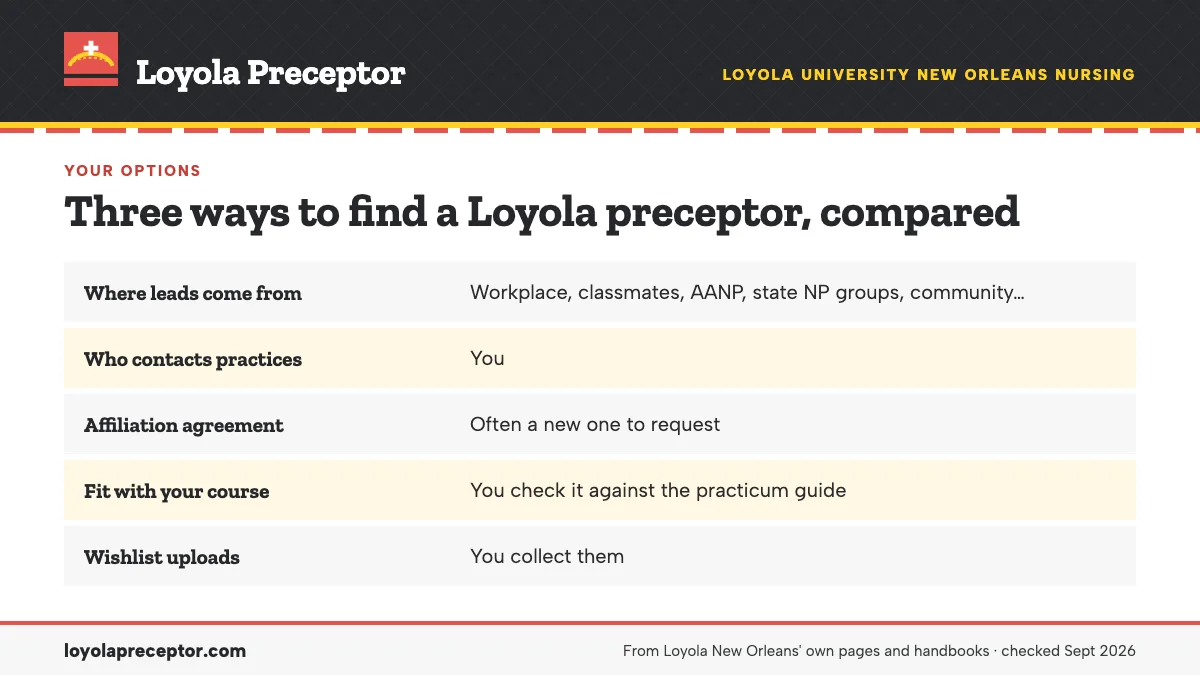
The three routes side by side
| Question | Your own network | Explore Clinical Locations | A placement service |
|---|---|---|---|
| Where leads come from | Workplace, classmates, AANP, state NP groups, community contacts | Organizations with an active Loyola agreement, listed in Exxat Prism | Your placement advisor's outreach near you |
| Who contacts practices | You | You, from a listing's basic contact details | Your placement advisor |
| Affiliation agreement | Often a new one to request | Already in place | Known before you commit, backup ready |
| Fit with your course | You check it against the practicum guide | You check it; a listing shows no preceptor or patient mix | Checked against Loyola's rules first |
| Wishlist uploads | You collect them | You collect them | Prepared for you to submit |
| If the preceptor leaves | You search again | You search again | A new search starts right away |
Your own network and the map are the routes Loyola builds in. A placement service adds outreach and preparation on top of them, and it can use both.
Route one: your own network
Loyola's FNP Orientation and Practicum Guide sends students to their workplace connections, fellow students, the AANP, state NP organizations and community contacts. It recommends walking into sites with a resume and a cover letter that names the course and its hours, following up, and pursuing several sites at once rather than waiting on one clinician.
This route shines when you already know a qualified clinician with room in the right term, or when your employer runs a clinic in a department where you do not work. A practicum at your own workplace needs the Employed at Clinical Site Attestation, with clinical hours in another department and at different times from your job. The finding your own preceptor page turns the guide's advice into a search plan.
Route two: the Explore Clinical Locations map
Loyola holds affiliation agreements with hundreds of organizations, and the Explore Clinical Locations map in Exxat Prism lets you browse them. A listed site skips the step that most often slows a placement, since the contract already exists and the request can move quickly.
The map lists organizations, though, not preceptors, and a listing says nothing about the patient mix. Opening a listing shows basic contact details; whether a clinician there has room, fits your course and will sign the Preceptor Agreement is still for you to learn. The Clinical Practicum Coordinator's published role covers placement tracking, agreements, compliance and Exxat help, so the conversation with the clinician stays with you. The Explore Clinical Locations page explains how to read a listing and use it course by course.
Route three: a placement service built for Loyola
With us, your placement advisor runs the outreach where you live and brings you preceptors who already understand the Loyola course, its hours and what the Preceptor Agreement asks of them. Each one is checked against Loyola's rules, and each site's agreement status is settled before you commit, including whether a site from the map actually has a preceptor with room.
You get the Wishlist items ready to submit and a partner who stays reachable until the term closes. For students working full time, facing a demanding course such as FPCM III, or living far from a busy clinic market, it is the most dependable way to reach Placement Approved in time. Each step is set out on how it works.
Questions that point to the right route
- How many weeks remain before your practicum term, measured against Loyola's three-month lead time?
- Does your course call for a population that is hard to find, such as the 150 pediatric and 50 obstetric hours in
NURS G829? - Has a board-certified clinician with more than 2,080 hours in practice already said yes to you?
- Is the site you have in mind on the Explore Clinical Locations map, or will it need a new agreement?
- What weekly time can you set aside for phone calls and site visits beside work and classes?
- Have practices already turned you down for this course?
When most answers point to a short runway and a narrow course, a service saves the most time. When a willing preceptor at a mapped site is already in hand, your own route may be all you need, and we can still review the packet before you submit it.
Mixing routes, and one rule to respect
Many searches blend the routes. Bring us a lead from your own network and we vet it and build the packet; name a site from the map and we find out whether a preceptor there has room; keep your own outreach going while ours runs. What matters is a single owner for each lead, so no practice gets two separate calls about one Loyola student.
Some health systems set their own terms for how requests arrive, and a well-meant call can cut against them. Ochsner LSU Health, as an example, asks that students not phone its providers directly and takes graduate requests only from the school's faculty or coordinator. The Louisiana NP preceptors page covers how the state's larger systems handle student requests.
Questions Loyola students ask
Does Loyola step in when a student's own search comes up empty?
Loyola's NP and DNP materials leave the choice of preceptor and site with the student, while the Clinical Practicum Coordinator obtains agreements, tracks compliance and helps with Exxat. If your search stalls, tell your course faculty and the coordinator early, and consider bringing in a placement service to run the outreach alongside them.
Is a site on the Explore Clinical Locations map easier to get?
The paperwork is lighter, because the affiliation agreement already exists. The preceptor is a separate question: a mapped site may have no clinician with room in your term, or may not see the patients your course needs. Think of the map as a list of places where one hurdle is already cleared.
How many sites should I approach at once?
More than one. Loyola's FNP guide advises pursuing several sites rather than a single preceptor, and the DNP practicum letter asks students to line up more than one option. A backup matters most when your first choice has no Loyola agreement, because a site-written contract can take months to clear.
Can I switch to a placement service partway through my search?
Yes. Send us what you have: practices contacted, the answers you got, any clinician who said maybe. We pick up from there, test each live lead against Loyola's rules and keep your timeline in view, so the effort you already put in shortens the search instead of being repeated.
Which route suits a DNP Scholarly Project practicum?
Project sites are often organizations you already know, such as a health system, a department of health or a professional association, so your own network is a natural starting point. Loyola bars family members, employers and direct supervisors as project preceptors, which can rule out the easiest option at your own workplace.
Related pages
Last checked 2026-09-25
We check these pages against Loyola's own bulletin, program pages, practicum guides, forms and licensure disclosures. Your plan of study, your practicum guide, your program director and the Clinical Practicum Coordinator have the final word.
Loyola asks you to select your own preceptor and site. We make that the easy part.
Tell us your Loyola program, where you live and which term your next practicum starts. We find preceptors whose patients fit the course, check whether the site already has a Loyola affiliation agreement, and prepare everything your Exxat Wishlist needs.
- Preceptors matched to the course: outpatient primary care for
NURS G823, pediatrics and obstetrics forNURS G829, acute care forNURS G902, psychiatric care forNURS G856 - Preceptor CV, license and Nursys PDF, the Preceptor Agreement and the site's signer details ready for the Wishlist
- In your own community, in Louisiana or any state where Loyola approves your practicum
Start your placement plan
Program, city and term is all we need to begin.