Louisiana APRN practice rules and what they mean for your preceptor
Louisiana nurse practitioners who diagnose and manage patients practice through a written collaborative practice agreement with a physician, and the state board sets its own rules for anyone who precepts an APRN student in Louisiana. Both shape which clinicians can precept a Loyola University New Orleans student, how their practices run, and what your graduate hours may count toward after you finish.
Get your placement plan
Tell us your Loyola program and where you live. A placement advisor replies with the preceptor and site options that fit your Loyola course.
Collaborative practice in Louisiana
Louisiana's rule on APRN practice, LAC 46:XLVII.4513, draws a line. APRNs who keep to the nursing scope of R.S. 37:913(3)(a) need no collaborative practice agreement; APRNs who perform medical diagnosis and management need one. That agreement covers the physician's (or dentist's) availability for consultation or referral, the methods for managing the practice, including clinical practice guidelines, and coverage when the physician is away.
For an NP student, this means an NP preceptor who diagnoses and treats patients in Louisiana works under an agreement with a named collaborating physician. The rule text was last amended in 2019. A 2021 bill for full practice authority, which paired independence with a transition-to-practice hour requirement, passed the House but was not enacted. Collaboration is the setting your Louisiana preceptor practices in, so it helps to ask who the collaborating physician is.
What a collaborative practice agreement contains
- A plan of accountability covering prescriptive authority, the physician's duties, hospital privileges, lab and diagnostic arrangements and records
- Clinical practice guidelines listing drug types or schedules, written for the specific site, kept on site and signed at least once a year
- Physician availability by phone or other telecommunication
- A plan for patient access when the APRN and the physician are both away
- A limit of two collaborating physicians at any one site, though a written organizational policy can name one alternate
The site's clinical practice guidelines set the limits of what your preceptor prescribes, and so of what you observe and practice under supervision there. A collaborating physician at the same practice can also be a preceptor option for NURS G823 and NURS G827, where Loyola's FNP guide accepts an NP, MD, DO or PA.
Prescriptive authority, and why your practicum hours matter later
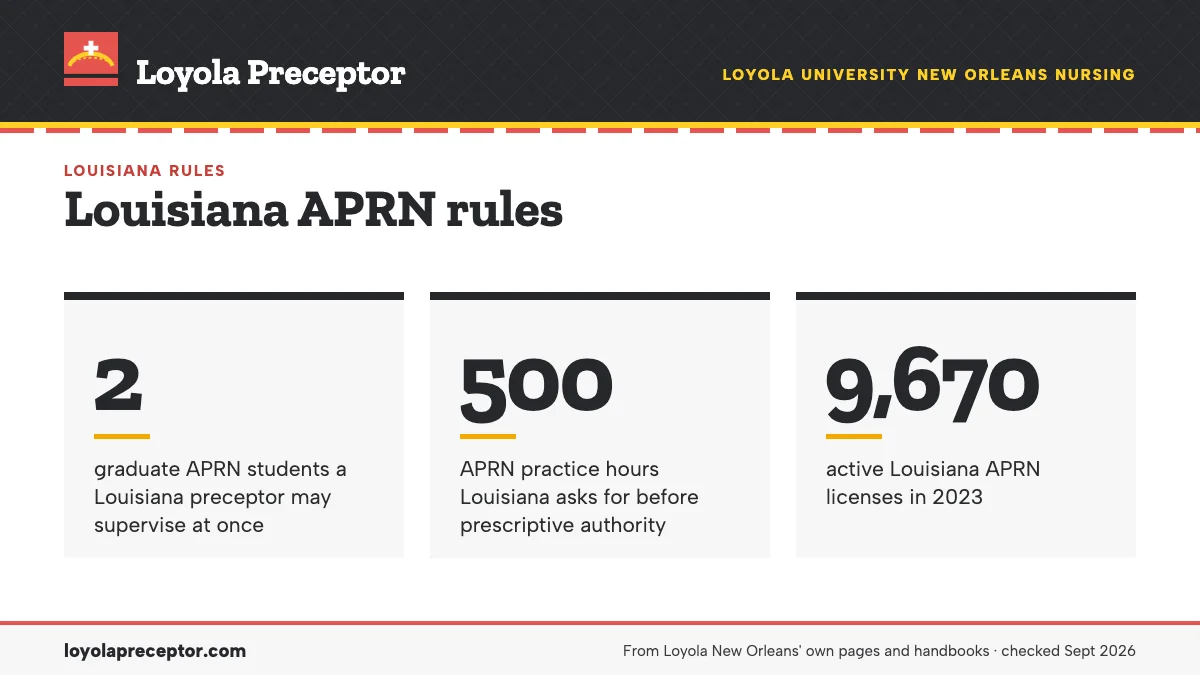
Prescribing in Louisiana takes a separate application after APRN licensure. It asks for current, unencumbered Louisiana RN and APRN licenses, national certification in your role and population, and the board's application with an Attestation of APRN Collaborative Practice. It also wants 500 practice hours, earned as a licensed APRN or as an applicant, in your role and population during the two years before applying.
Graduate clinical hours that met your certification eligibility may be accepted toward those 500 hours, and practice in another state can count. The rule also calls for at least 45 contact hours each in advanced pharmacotherapeutics, advanced physiology and pathophysiology, and advanced health assessment. Controlled substances add three hours of board-approved CE, a Louisiana CDS license and DEA registration. Hold on to your Exxat hour records and course documents, since they show hours you may lean on later.
LSBN's rule for preceptors in Louisiana
LAC 46:XLVII.3543 is the Louisiana State Board of Nursing's rule for preceptorships, and it covers every APRN student precepted anywhere in the state. For graduate students, it comes down to these points:
| Topic | What the rule says |
|---|---|
| Learning experiences | Nurse faculty keep responsibility for selecting and guiding them and for evaluation, with preceptor input |
| Choosing preceptors | By written criteria that faculty and the facility's nursing administration develop together |
| Faculty contact | A faculty member is available to preceptors and confers with each preceptor and student at least weekly |
| Faculty load | No more than 1 faculty member to 9 APRN students in preceptorships |
| Preceptor load | No more than two graduate APRN students in any given clinical experience |
| Preceptor license | An active, unencumbered Louisiana RN and/or APRN license |
| Population focus | Most graduate clinical time with an APRN licensed and certified in the same population focus; other clinicians may add interprofessional experience |
The two-student cap matters most in a busy practice that already hosts learners from other programs: a preceptor at the limit has no room, however willing.
Where Loyola's standards and Louisiana's meet
Loyola's FNP guide wants the preceptor licensed without restriction where the site is, board certified, past the one-year (2,080-hour) mark in practice, unrelated to you and present for every hour. At a Louisiana site, the board's rule layers on the student cap, the weekly faculty contact and the expectation that most clinical time is spent with an APRN in your population focus.
That last point deserves planning. Loyola lets physicians and PAs precept FPCM I and II, but across your program, Louisiana expects the larger share of hours with an APRN in your population. Your program director confirms how Loyola applies the rule to your plan of study, and the preceptor requirements page has Loyola's full list.
Clinical sites, written agreements and out-of-state schools
The board's clinical facility rule, LAC 46:XLVII.3529, calls for written school-agency agreements that cover liability insurance and include a termination clause, and for board approval of every agency, obtained with a clinical facility survey no later than four weeks before students use it. At Loyola, that written agreement is either Loyola's standard contract or a form the site drafts; the affiliation agreements page explains both.
Schools based outside Louisiana face a heavier rule, LAC 46:XLVII.3539: a request to the board at least six months ahead, a clinical facility survey, faculty who hold Louisiana licenses and visit at least once per term, and reports to the board as each experience starts. Loyola is a Louisiana school whose programs LSBN approves, so that out-of-state process is not part of its students' path.
Why Loyola students choose us for Louisiana placements
Before a Louisiana name reaches you, your placement advisor tests it against both sets of rules: Loyola's license, certification and experience standards, and the board's license requirement and two-student cap. We also ask how the practice's collaborative agreement shapes the preceptor's scope, so the site suits your course before you commit. At a busy practice we also ask how many students the preceptor already has, so the two-student cap never surprises you in week one.
The result is a Louisiana placement built to fit Loyola's process from the first submission. Tell us your course and parish through the form below, and see Louisiana NP preceptors for how the state's health systems handle student requests, or the New Orleans page for the metro.
Questions Loyola students ask
Do Louisiana NPs need a supervising physician?
Louisiana's rule speaks of collaboration rather than supervision. An APRN who diagnoses and manages patients needs a collaborative practice agreement with a physician (or dentist) covering consultation, referral, practice guidelines and coverage during absences. An APRN working only within the nursing scope needs none.
Will my Loyola practicum hours help with Louisiana prescriptive authority?
Possibly. Louisiana asks for 500 hours of APRN practice in the two years before you apply, and it allows graduate clinical hours that met your certification eligibility to be accepted. The board makes that call, so keep complete hour logs, signed by your preceptors, from every Loyola practicum.
Why might a Louisiana preceptor say there is no room for me?
One possible reason is the board's limit. A preceptor in Louisiana may supervise no more than two graduate APRN students in any clinical experience, so a clinician already teaching two students from any school has to wait. Asking early, before other programs fill the term, gives you the best chance.
Does Louisiana give preceptors a tax credit?
Louisiana law has no preceptor tax credit. Its existing credit under R.S. 47:297(H) is aimed at primary care NPs and other clinicians who practice in rural high-need shortage areas, and precepting is not part of it. The federal PRECEPT Nurses Act would create a credit for precepting in shortage areas, but it is only a bill.
What does a new Loyola graduate need to practice as an NP in Louisiana?
A current, unencumbered Louisiana or multistate RN license, completion of an accredited master's, doctoral or post-master's program in your APRN role and population, and national certification from a board-approved body. You then apply for APRN licensure by examination through the Louisiana Nurse Portal. Prescribing needs its own application after that.
Related pages
Last checked 2026-09-25
We check these pages against Loyola's own bulletin, program pages, practicum guides, forms and licensure disclosures. Your plan of study, your practicum guide, your program director and the Clinical Practicum Coordinator have the final word.
Loyola asks you to select your own preceptor and site. We make that the easy part.
Tell us your Loyola program, where you live and which term your next practicum starts. We find preceptors whose patients fit the course, check whether the site already has a Loyola affiliation agreement, and prepare everything your Exxat Wishlist needs.
- Preceptors matched to the course: outpatient primary care for
NURS G823, pediatrics and obstetrics forNURS G829, acute care forNURS G902, psychiatric care forNURS G856 - Preceptor CV, license and Nursys PDF, the Preceptor Agreement and the site's signer details ready for the Wishlist
- In your own community, in Louisiana or any state where Loyola approves your practicum
Start your placement plan
Program, city and term is all we need to begin.