Loyola New Orleans BSN-DNP FNP: two practicum tracks in one plan
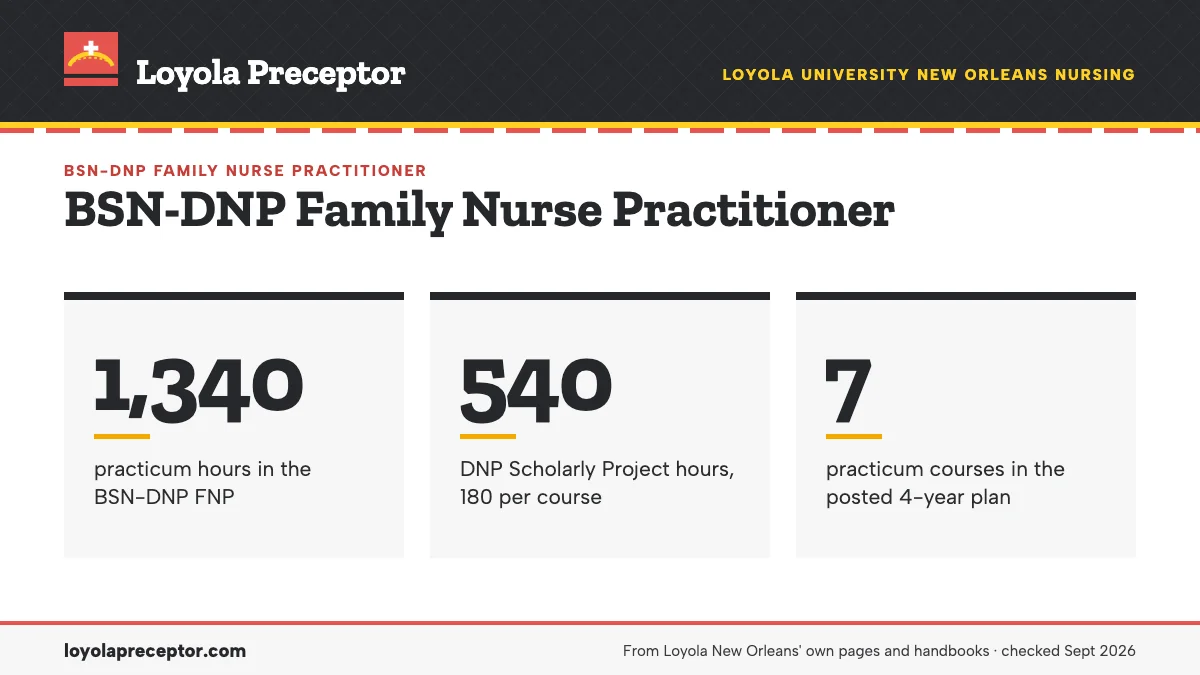
The BSN-DNP Family Nurse Practitioner at Loyola University New Orleans is a 63-credit online program with 1,340 practicum hours: 800 in the four FPCM clinical courses and 540 in three DNP Scholarly Project practicums. The posted plan interleaves the two, so in one term you need a project site and a clinical site at the same time. Here is the sequence, and what each kind of placement asks of you.
Get your placement plan
Tell us your Loyola program and where you live. A placement advisor replies with the preceptor and site options that fit your Loyola course.
How the BSN-DNP FNP is built
The bulletin lists 63 credits, online and asynchronous, with Fall, Spring and Summer starts. Loyola's program page describes a 36-month program, while the plan on the graduate resources page runs four years, Fall I through Spring IV. Follow your own plan of study, and ask the FNP/DNP Program Director if the two sources leave your finish date unclear.
Graduates are prepared for the AANP or ANCC Family Nurse Practitioner exam. Clinical admission items mirror the MSN track: an RN license from any US state to apply (plus an APRN license where practicums occur, if you already hold one), a Louisiana or multistate license in hand by semester two, and a B- or better in statistics.
Should you later decide the MSN FNP suits you better, the handbook requires a Change of Program Request Form; you must also have passed a practicum course, and other criteria apply.
Seven practicums in the 4-year plan
The first practicum is a project course, not a clinical one. From Summer II onward, every term through Spring IV carries at least one practicum, six terms in a row, and Spring III carries two.
| Term | Course | Hours | Kind of site |
|---|---|---|---|
| Summer II (term 6) | NURS G939 DNP Scholarly Project I: Planning and Proposal | 180 | Project setting with a project preceptor |
| Fall III (term 7) | NURS G823 FPCM I Practicum | 200 | Outpatient primary care |
| Spring III | NURS G942 DNP Scholarly Project II: Implementation | 180 | Project setting |
| Spring III | NURS G827 FPCM II Practicum | 200 | Outpatient primary care |
| Summer III | NURS G944 DNP Scholarly Project III: Evaluation and Dissemination | 180 | Project setting |
| Fall IV | NURS G829 FPCM III Practicum | 200 | 150 pediatric plus 50 obstetric hours |
| Spring IV | NURS G833 FPCM IV Practicum | 200 | Final primary care hours |
Course pages carry the detail: FPCM I, FPCM II, FPCM III, FPCM IV and the three DNP project practicums.
Spring III: two placements at once
Spring III is the heaviest clinical term in the plan. NURS G942 asks for 180 project hours, roughly 12 a week at Loyola's rate of 60 hours per credit, while NURS G827 asks for 200 hours of outpatient family practice. That means two preceptors, two Exxat requests and, unless both sit inside one organization, two affiliation agreements running in the same semester.
Both requests have to reach Placement Approved before their hours start. Spring classes begin in mid-January (January 19 in 2027), so Loyola's three-month lead time puts both searches in motion by mid-October of Fall III, while you are still logging NURS G823 hours. Running the two in parallel keeps one slow site from holding up the other course.
Because the project courses run from planning to implementation to evaluation, keeping one project setting from NURS G939 onward is the simplest route, and it leaves only the clinical site to find for spring. Confirm with your scholarly project advisor that your Summer II setting can host the implementation phase before you count on it.
Spring III needs two approved placements before classes begin in January, so start both searches early in the fall.
The project preceptor is a different search
Project practicums follow Loyola's DNP practicum requirements letter, not the FNP clinical rules. You choose a site that serves the course outcomes and the DNP Essentials, and the letter's list of possibilities is broad: a health department, an ethics committee, a CDC program, a policy internship, a professional nursing association or a health care organization.
The preceptor might be a chief officer, a VP of patient care, a nursing director or administrator, an organizational leader, an APRN or a physician. Whoever it is holds an unencumbered license where the practicum happens and supervises your hours directly; relatives, employers and the person you report to are excluded. The letter also tells students to start early and keep more than one candidate in play.
In place of the FNP Preceptor Agreement, the project has its own form, the DNP Scholarly Project Preceptor-Student Agreement, which you, the preceptor and a Loyola faculty member sign once for all three project courses. Expect your preceptor and your scholarly project advisor to talk every semester, by phone or on Zoom. If your project would sit at your own workplace, read the employer rules first.
The clinical half matches the MSN, a year later
The direct-care hours are the same four 200-hour Family Primary Care Management practicums MSN students take, all in outpatient primary care, with FPCM III split into 150 pediatric and 50 obstetric hours. What changes is timing: you reach FPCM I in term 7 instead of term 4, and finish FPCM IV in Spring IV.
The later start has a practical upside. By the time NURS G823 begins, you will have already taken one placement through Exxat for NURS G939, so the Wishlist fields, the preceptor uploads and the approval stages are familiar. The MSN FNP page shows the shorter clinical sequence for comparison.
Clinical preceptors follow the FNP guide rather than the DNP letter: FPCM I and II accept an NP, MD, DO or PA as preceptor, FPCM III's supervisor has to match its pediatric and obstetric caseload, and a specialty site in FPCM IV waits on the FNP Director's approval.
Why BSN-DNP FNP students choose us
We map all seven placements against your 4-year plan and run the project and clinical searches as one schedule, so Spring III opens with both sites approved. For NURS G939 through NURS G944 we look for project settings and leaders who fit your topic and meet the letter's rules; for the FPCM courses we find outpatient family practices, plus pediatric and obstetric coverage for NURS G829.
Each site reaches you with its Exxat details gathered, the right agreement form identified (the Preceptor Agreement or the DNP Scholarly Project Preceptor-Student Agreement), and an early answer on whether Loyola already holds an affiliation agreement there. If a preceptor steps away mid-program, the replacement search starts the same day. Loyola's Clinical Practicum Coordinator and your faculty review and approve each placement; we hand them a request with nothing missing. Use the form below to begin.
Questions Loyola students ask
How many clinical hours is Loyola's BSN-DNP FNP?
1,340 in total: 800 hours across the four FPCM practicums and 540 across the three DNP Scholarly Project practicums at 180 each. Only the 800 are direct-care family practice hours; the project hours are completed in a project setting under a project preceptor. Students from earlier cohorts should confirm their per-course figures on their own plan of study.
Is the BSN-DNP FNP three years or four?
Loyola's program page says 36 months, while the plan posted on the graduate resources page runs four years, Fall I through Spring IV. Your plan of study is the schedule to follow. Whatever the length, the five-year completion limit for Loyola graduate nursing starts with your first course, and an approved year of leave is counted inside it.
Can my nurse manager serve as my DNP project preceptor?
No. The DNP practicum requirements letter rules out anyone you report to, as well as your employer and your relatives, even when the project fits your unit perfectly. If you want a project inside the organization where you work, clear the setting and the preceptor first with your scholarly project advisor, and loop in the Clinical Practicum Coordinator, before anyone signs.
When does the first BSN-DNP FNP practicum start?
In the posted plan, the first practicum is NURS G939 in Summer II, term 6, and the first direct-care FNP practicum is NURS G823 in Fall III, term 7. Summer terms open in mid-May, and Loyola's three-month lead time pushes that first project request back into Spring II.
Can I switch from the BSN-DNP FNP to the MSN FNP?
The handbook allows it through a Change of Program Request Form, with at least one passed practicum course among the criteria. Because the MSN places FPCM I earlier in its plan, a switch can change which practicum you take next and when, so talk to the FNP/DNP Program Director before you open another site search.
Related pages
Last checked 2026-09-25
We check these pages against Loyola's own bulletin, program pages, practicum guides, forms and licensure disclosures. Your plan of study, your practicum guide, your program director and the Clinical Practicum Coordinator have the final word.
Loyola asks you to select your own preceptor and site. We make that the easy part.
Tell us your Loyola program, where you live and which term your next practicum starts. We find preceptors whose patients fit the course, check whether the site already has a Loyola affiliation agreement, and prepare everything your Exxat Wishlist needs.
- Preceptors matched to the course: outpatient primary care for
NURS G823, pediatrics and obstetrics forNURS G829, acute care forNURS G902, psychiatric care forNURS G856 - Preceptor CV, license and Nursys PDF, the Preceptor Agreement and the site's signer details ready for the Wishlist
- In your own community, in Louisiana or any state where Loyola approves your practicum
Start your placement plan
Program, city and term is all we need to begin.