Doing your Loyola University New Orleans practicum where you work
Loyola allows a practicum at your own employer once you file the Employed at Clinical Site Attestation, which keeps your student hours in another department and outside your paid schedule. DNP project students carry one more limit, because their preceptor cannot be their employer or direct supervisor.
Get your placement plan
Tell us your Loyola program and where you live. A placement advisor replies with the preceptor and site options that fit your Loyola course.
Yes, with two conditions and three signatures
Plenty of Loyola nurse practitioner students keep working as RNs, and the FNP guide itself points to your workplace network as a place to look for preceptors. Loyola answers the workplace question with a form rather than a ban: the Employed at Clinical Site Attestation.
The 2025 attestation sets two conditions. Your practicum hours take place in a department separate from the one you work in, and at times different from your work hours. Three people sign it: you, your work supervisor and your preceptor or facilitator.
Handled well, it is one of the most practical routes a working nurse has. You already know which teams in your system have strong primary care or acute care providers; the attestation simply asks you to prove that your student time and your paid time never share a department or a clock.
What separate department and separate hours look like
The test is whether anyone reviewing your file can tell student hours from paid hours at a glance. These examples show the idea; your course faculty decide on any specific arrangement.
- A medical-surgical RN who completes FPCM hours at the same health system's outpatient family practice, on days off from the unit.
- An ICU nurse in the AGACNP track who rotates with a hospitalist or interventional radiology team elsewhere in the hospital, never on a shift they are scheduled to work.
- A clinic nurse who trains with an NP at a different clinic location of the same employer, on weekdays that are not their clinic workdays.
What fails the test is the blended shift: seeing patients as an NP student during hours you are paid as an RN, or logging practicum time in your own department. Keep your work schedule and your Exxat hour log clean enough that the two never overlap.
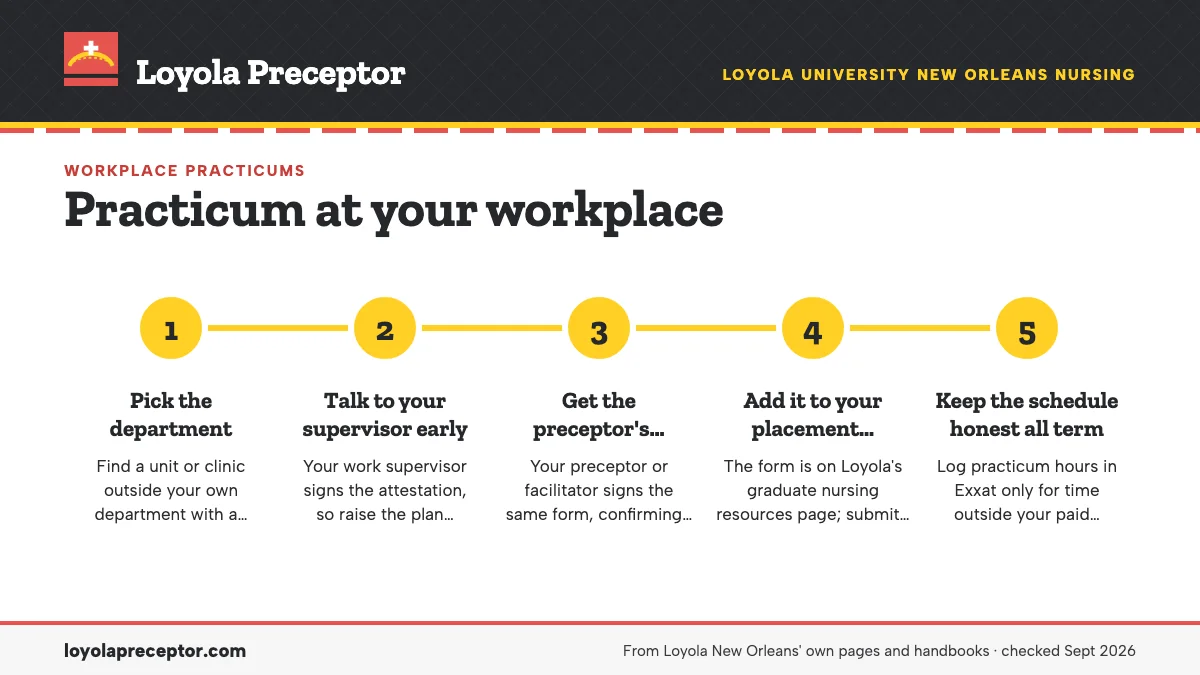
Filing the attestation, step by step
- Pick the departmentFind a unit or clinic outside your own department with a preceptor who meets Loyola's rules for your course.
- Talk to your supervisor earlyYour work supervisor signs the attestation, so raise the plan before anything else and agree on how your work and practicum schedules will stay apart.
- Get the preceptor's signatureYour preceptor or facilitator signs the same form, confirming the separate department and hours.
- Add it to your placement paperworkThe form is on Loyola's graduate nursing resources page; submit it with the rest of your request, and ask the Clinical Practicum Coordinator where it belongs in Exxat.
- Keep the schedule honest all termLog practicum hours in Exxat only for time outside your paid shifts, and keep your work schedule on hand in case faculty ask.
File it alongside the Wishlist rather than after approval, so the request reaches the Clinical Practicum Coordinator complete.
Your employer still needs an agreement with Loyola
Working somewhere does not make it an approved practicum site. The bulletin keeps any practicum from starting until every party has put its signature on the affiliation agreement, and your own employer is no exception. The affiliation agreements page explains the Standard Loyola Affiliation Agreement and the slower path for site-written contracts.
Large systems add steps of their own. Ochsner LSU Health, in North Louisiana, says on its own page that only a school's faculty or coordinator enters graduate nursing requests, that students should not call providers, and that it gives priority to its own employees and highly rated programs. Read your employer's student-placement page before you approach anyone there.
One more wrinkle: the Preceptor Agreement also calls for an agreement with the preceptor's own employer if it differs from the site, as with a physician group practicing inside a hospital.
DNP projects: the employer and supervisor rule
DNP Scholarly Project students often want a project inside their own organization, which suits quality and systems work. The DNP practicum requirements letter draws a firm line: the project preceptor cannot be a relative, cannot be your employer and cannot be the person you report to. Read literally, the employer limit could reach anyone acting for your employer, so confirm your choice with your scholarly project advisor before you ask.
Loyola's documents do not line up on how far this reaches for FNP students. The FNP guide lists only the family limit, the DNP letter adds employers and direct supervisors, and the attestation permits workplace practicums under its two conditions. An FNP student considering a manager as preceptor should put the question to the FNP Program Director in writing first.
More on project sites and preceptors is on the DNP Scholarly Project practicums page.
Why the separation protects you
Loyola's School of Nursing covers your practicum hours with malpractice insurance, and the handbook draws the line there: the policy does not follow you into work outside the practicum. A clean split makes it obvious which hours you worked as a Loyola student and which you worked for your employer. The liability insurance page covers the coverage and the certificates posted for sites.
It protects your evaluation, too. Your preceptor signs your practicum log and completes the Practicum Evaluation Form, and that judgment carries more weight when it rests on your work as a student rather than on your reputation as a colleague.
Undergraduates get a stricter version: a BSN student's preceptorship cannot take place on the student's own unit.
Your workplace network, with a backup ready
Your employer is often the quickest first call, and we treat it that way. We map which departments in your system could host your course, confirm whether your organization is already under a Loyola agreement, and line up the three attestation signatures before the Wishlist goes in.
Workplace plans stall for ordinary reasons: a supervisor declines, a department is short on providers, a legal office rewrites the agreement. We run an outside search in your area at the same time, with preceptors who meet Loyola's rules, so a stalled workplace plan does not have to cost you the term. Loyola's placement office and faculty make the final call on every placement, and the packet we build gives them everything they need at once. The how it works page shows each stage; the form below starts yours.
Questions Loyola students ask
Can I do my Loyola FNP practicum at the hospital where I work?
Yes, if you file the Employed at Clinical Site Attestation. Your practicum hours must be in a department separate from yours and at different times from your work hours, and you, your supervisor and your preceptor sign the form. The hospital also has to be under a signed Loyola affiliation agreement before a single hour counts.
Can my nurse manager be my preceptor?
Not for a DNP project practicum, where the letter bars both employers and direct supervisors from the preceptor role. The FNP guide's only stated exclusion is family, yet the attestation's separate-department condition points you toward someone outside your own unit. Ask the FNP Program Director before approaching a manager.
Can I count my paid work hours as clinical hours?
No. The attestation requires practicum hours at times different from your work hours, and Loyola's malpractice coverage applies to practicum hours, not to work outside the practicum. Log in Exxat only the time you spend as a student with your preceptor.
Do I need a Preceptor Agreement if I already work with the preceptor?
Yes. Every preceptor signs Loyola's Preceptor Agreement, and you upload it with the Wishlist together with the preceptor's CV and license. A working relationship does not replace the paperwork, and the agreement also confirms that an affiliation agreement exists with the preceptor's employer.
Can BSN students do clinicals on the unit where they work?
Not for the undergraduate preceptorship, which Loyola's handbook keeps off any unit where the student is employed; students name three areas of clinical interest and program faculty finalize the unit. Loyola arranges BSN clinical placements through its partner Ochsner Health.
Related pages
Last checked 2026-09-25
We check these pages against Loyola's own bulletin, program pages, practicum guides, forms and licensure disclosures. Your plan of study, your practicum guide, your program director and the Clinical Practicum Coordinator have the final word.
Loyola asks you to select your own preceptor and site. We make that the easy part.
Tell us your Loyola program, where you live and which term your next practicum starts. We find preceptors whose patients fit the course, check whether the site already has a Loyola affiliation agreement, and prepare everything your Exxat Wishlist needs.
- Preceptors matched to the course: outpatient primary care for
NURS G823, pediatrics and obstetrics forNURS G829, acute care forNURS G902, psychiatric care forNURS G856 - Preceptor CV, license and Nursys PDF, the Preceptor Agreement and the site's signer details ready for the Wishlist
- In your own community, in Louisiana or any state where Loyola approves your practicum
Start your placement plan
Program, city and term is all we need to begin.