Loyola University New Orleans Accelerated BSN: 17 months of clinicals in Greater New Orleans
Loyola New Orleans' hybrid Accelerated BSN turns a bachelor's in another field into a BSN in 17 months, and Loyola arranges the clinicals with partner healthcare organizations in Greater New Orleans. You supply the time and the local presence; the program supplies the sites. Here is how the clinical courses, the hybrid schedule and clearance before clinicals fit together.
Get your placement plan
Tell us your Loyola program and where you live. A placement advisor replies with the preceptor and site options that fit your Loyola course.
Clinicals are arranged for you
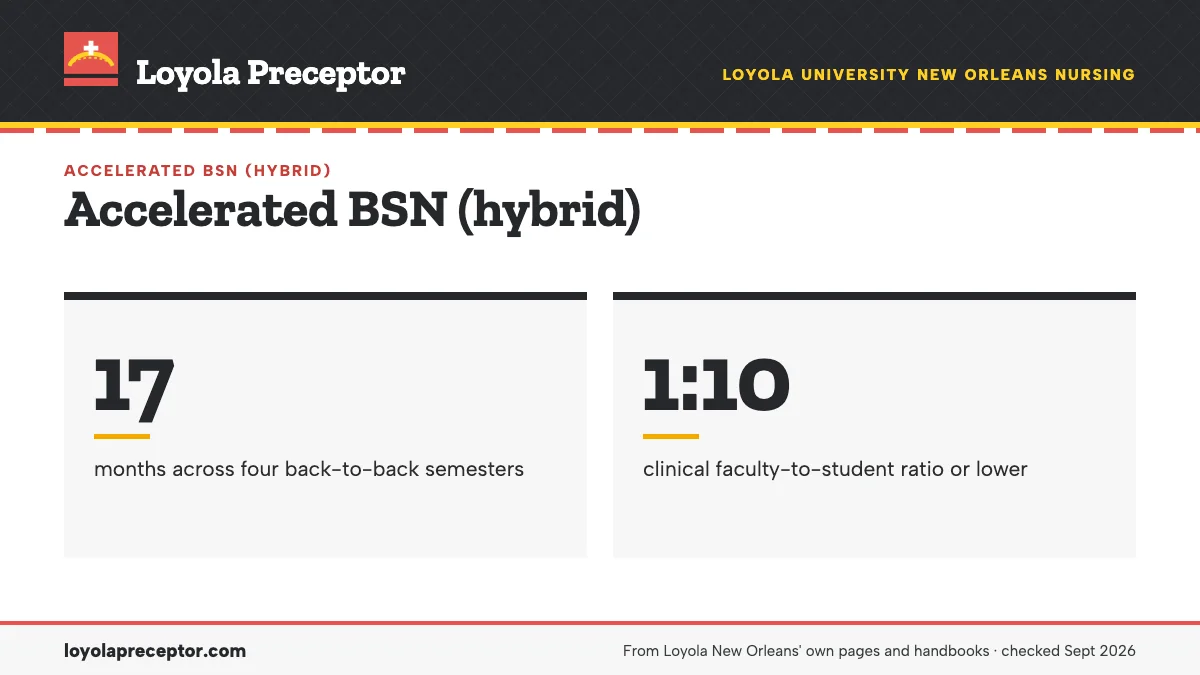
Loyola's ABSN page states that students receive clinical placements with partner healthcare organizations in the Greater New Orleans area, and it presents those placements as assured. Clinical faculty-to-student ratios are 1:10 or lower.
The other side of that promise is a location requirement: applicants must be able to complete clinicals in Greater New Orleans. Theory runs online, but clinical days are local, so anyone living outside the metro needs a plan to be there for every rotation, all 17 months.
Loyola's bulletin, program page and handbook do not publish hours for each ABSN clinical course or a term-by-term plan. Your clinical instructors and course syllabi hold that detail, and they are the people to ask when you are planning work, family or travel around a semester.
Four semesters, back to back
The ABSN runs 17 months across four consecutive semesters, summer included, as a full-time program, and Loyola advises against working full time while enrolled. The bulletin and program page list 54 credits, while the Nursing Student Handbook says 53; confirm the figure with your advisor.
Applications are due November 1. Loyola's pages do not state the start term, so ask admissions when your cohort begins. Admission calls for a prior bachelor's outside nursing and prerequisites passed with a C or better, which transfer if completed within ten years.
The pace shapes clinical life. With no break between semesters, yearly items such as the physical and the flu vaccine can come due in the middle of the program, so put every renewal date on a calendar in your first week.
The hybrid rhythm
Theory courses are synchronous online, held at set times rather than self-paced. Skills checks are in person at scheduled times, and the simulation lab is open to ABSN students from the first semester. Clinical days take place at the partner organizations. The simulation lab itself is on the 5th floor of Monroe Hall on the Uptown campus, stocked with birthing simulators, wearable prostheses and mannequins at both low and high fidelity.
Across the program you therefore juggle three kinds of fixed appointment: live online classes, campus skills sessions and clinical shifts. Settle all three before you commit to anything else in a given semester.
Canvas carries your courses, which the handbook expects you to open every day. Your Loyola single sign-on also opens LORA, where the Holds tab shows why registration might be blocked, and the handbook's own example is a missing immunization record. The student systems page explains what each system does.
The seven clinical courses
The ABSN folds the traditional BSN's two Foundations clinicals into one course, NURS G212, and then shares the same six specialty clinical courses.
| Course | Title | Credits |
|---|---|---|
NURS G212 | Foundations of Nursing Practice Clinical/Practicum | 2 |
NURS G362 | Adult Health Nursing I Clinical/Practicum | 3 |
NURS G373 | Child Health Nursing Clinical/Practicum | 2 |
NURS G375 | Women's Health Nursing Clinical/Practicum | 2 |
NURS G431 | Mental Health Nursing Clinical/Practicum | 2 |
NURS G464 | Adult Health Nursing II Clinical/Practicum | 3 |
NURS G484 | Population Health Clinical/Practicum | 2 |
Adult Health Nursing II is the course the handbook links to the undergraduate preceptorship, a 180-hour experience in which students name areas of interest and faculty finalize the unit. Ask your clinical instructor how that fits the accelerated calendar. The traditional BSN page walks through the preceptorship steps and preceptor qualifications.
Clearance before clinicals
ABSN students clear the same pre-licensure list as the traditional BSN before any clinical work. The state-level piece comes first: an LSBN student nursing license, applied for with its own background check, since Louisiana requires board approval before an undergraduate enrolls in a clinical course.
Loyola's own items sit alongside it: the School of Nursing background check through its contracted company, a urine drug screen at a designated facility, a yearly physical, BLS, health insurance and the immunization series. The background check and drug screen page explains reporting rules, and the immunizations page lists each vaccine.
Two points about the drug screen deserve attention. Positive results go to three places: the LSBN, the Program Director and the School of Nursing Director. A medical cannabis card changes nothing here, and under the clinical affiliation agreements a student in that position cannot attend clinicals.
Start the LSBN application as soon as you are admitted. It runs through the state board rather than Loyola, and your first clinical course waits on it.
Your first ABSN clinical cannot start without an LSBN student nursing license; the application goes to the state board, separate from Loyola's own checks.
After the ABSN: the road to graduate practicums
The ABSN prepares you for the NCLEX. Loyola's pre-licensure licensure table shows the program meeting educational requirements in every listed state except Puerto Rico, which is undetermined, and the State Approvals Map adds a New York restriction the table leaves out. If you plan to move after graduation, read the licensure disclosures first.
If a nurse practitioner role is your longer plan, Loyola's graduate programs ask for at least one year of full-time RN work before admission. Then the rules change: in the online MSN FNP, the BSN-DNP tracks and the post-graduate certificates, Loyola expects you to choose your own preceptor and site, and the request runs through Exxat with at least three months of lead time.
That step is our specialty. We source preceptors matched to the Loyola course in your own area, confirm early whether Loyola already has an agreement with the site, and prepare the Wishlist details before the placement office sees them. Bookmark the MSN FNP page for later, and use the form when your first graduate practicum is on the horizon.
Questions Loyola students ask
Does Loyola place Accelerated BSN students in clinicals?
Yes. Loyola's ABSN page says students receive clinical placements with partner healthcare organizations in the Greater New Orleans area, with a clinical faculty-to-student ratio of 1:10 or lower. Applicants must be able to complete clinicals in that area, so living within reach of the metro matters.
Is Loyola's Accelerated BSN online?
It is hybrid. Theory classes are synchronous online at set times, skills checks are in person at scheduled times, and clinicals happen with partner organizations in Greater New Orleans. You need to be local for the in-person skills checks and every clinical rotation, even though lectures are online.
How long is Loyola's ABSN, and can I work during it?
It lasts 17 months across four back-to-back semesters, summer included, as a full-time program, and Loyola does not recommend working full time during it. The credit count is 54 in the bulletin and on the program page, and 53 in the Nursing Student Handbook.
What do I need before ABSN clinicals start?
An LSBN student nursing license with its background check, the School of Nursing background check, a urine drug screen, a yearly physical, BLS, health insurance and immunizations. The list matches the traditional BSN's pre-licensure requirements, and every item must be complete before any clinical work.
When is the Loyola ABSN application deadline?
Loyola lists November 1 as the application deadline, and its pages do not state the start term, so confirm it with admissions. You need a prior bachelor's in another field and prerequisites passed with a C or better, transferable if taken within ten years.
Is Loyola's Accelerated BSN accredited?
Yes. According to Loyola, the Commission on Collegiate Nursing Education (CCNE) accredits its baccalaureate, master's and DNP nursing programs, and every School of Nursing program carries Louisiana State Board of Nursing approval. At the university level, the accreditor is SACSCOC. See the accreditation page for the scope of each.
Related pages
Last checked 2026-09-25
We check these pages against Loyola's own bulletin, program pages, practicum guides, forms and licensure disclosures. Your plan of study, your practicum guide, your program director and the Clinical Practicum Coordinator have the final word.
Loyola asks you to select your own preceptor and site. We make that the easy part.
Tell us your Loyola program, where you live and which term your next practicum starts. We find preceptors whose patients fit the course, check whether the site already has a Loyola affiliation agreement, and prepare everything your Exxat Wishlist needs.
- Preceptors matched to the course: outpatient primary care for
NURS G823, pediatrics and obstetrics forNURS G829, acute care forNURS G902, psychiatric care forNURS G856 - Preceptor CV, license and Nursys PDF, the Preceptor Agreement and the site's signer details ready for the Wishlist
- In your own community, in Louisiana or any state where Loyola approves your practicum
Start your placement plan
Program, city and term is all we need to begin.