Loyola University New Orleans BSN clinicals: eight rotations, Ochsner placements and the preceptorship
Loyola New Orleans places its traditional BSN students in clinicals itself: the BSN page promises placements through partner Ochsner Health across eight clinical rotations in the last two years. As a BSN student, the site search is the School of Nursing's job. This page explains the clinical courses, the 180-hour preceptorship and what to have ready, and where we fit later, when you move on to graduate study.
Get your placement plan
Tell us your Loyola program and where you live. A placement advisor replies with the preceptor and site options that fit your Loyola course.
How BSN placements work
Loyola's BSN page promises clinical placements through its partner Ochsner Health and describes eight clinical rotations in the final two years of the program. That statement is Loyola's own, it concerns the BSN, and it answers who finds your sites: the School of Nursing does.
The undergraduate preceptorship follows a similar pattern with more input from you. You name three areas of clinical interest tied to Adult Health II, and program faculty finalize the unit. One firm rule applies: you may not precept on a unit where you work.
Ochsner's own career pages describe undergraduate nursing clinicals with RN preceptors and an Ochsner Scholars tuition program for students at schools in Louisiana or Mississippi. Those are Ochsner's descriptions of its own programs; your placements themselves come through Loyola and your clinical instructors.
The eight clinical courses
The BSN is 120 credits, 69 of them in the nursing major, and you spend all four years on the Uptown New Orleans campus. Year one is Pre-Nursing, and nursing courses begin in the Fall of year two. The undergraduate bulletin lists eight clinical/practicum courses but publishes neither a term-by-term order nor hours for each one.
| Course | Title | Credits |
|---|---|---|
NURS G210 | Foundations of Nursing Practice I Clinical/Practicum | 2 |
NURS G211 | Foundations of Nursing Practice II Clinical/Practicum | 2 |
NURS G362 | Adult Health Nursing I Clinical/Practicum | 3 |
NURS G373 | Child Health Nursing Clinical/Practicum | 2 |
NURS G375 | Women's Health Nursing Clinical/Practicum | 2 |
NURS G431 | Mental Health Nursing Clinical/Practicum | 2 |
NURS G464 | Adult Health Nursing II Clinical/Practicum | 3 |
NURS G484 | Population Health Clinical/Practicum | 2 |
The one BSN hour figure Loyola publishes is the preceptorship's 180 clinical hours. For every other clinical course, your syllabus and clinical instructor give the hours and schedule. Applications for the BSN are accepted year-round, and most students finish in four years.
Before your first clinical day
No clinical work begins until your file is complete. The undergraduate bulletin's list starts with the state: an application for an LSBN student license, which brings a separate board background check. Loyola then asks for its own background check, a physical every year, BLS, a urine drug screen, health insurance and immunizations. The Nursing Student Handbook is explicit that the LSBN student license has to be in hand before your first Louisiana clinical course, and Loyola's undergraduate resources page links the board's instructions for clinical enrollment.
You pay for the drug screen, taken at a facility the School of Nursing designates. A positive result is reported to the LSBN as well as to the School of Nursing and Program Directors, and a medical marijuana card offers no exemption. The background check runs through the School of Nursing's contracted company, also at your expense.
Our compliance requirements page lists every item, and the immunizations and TB page covers the vaccine series and the TB risk assessment.
The 180-hour preceptorship, step by step
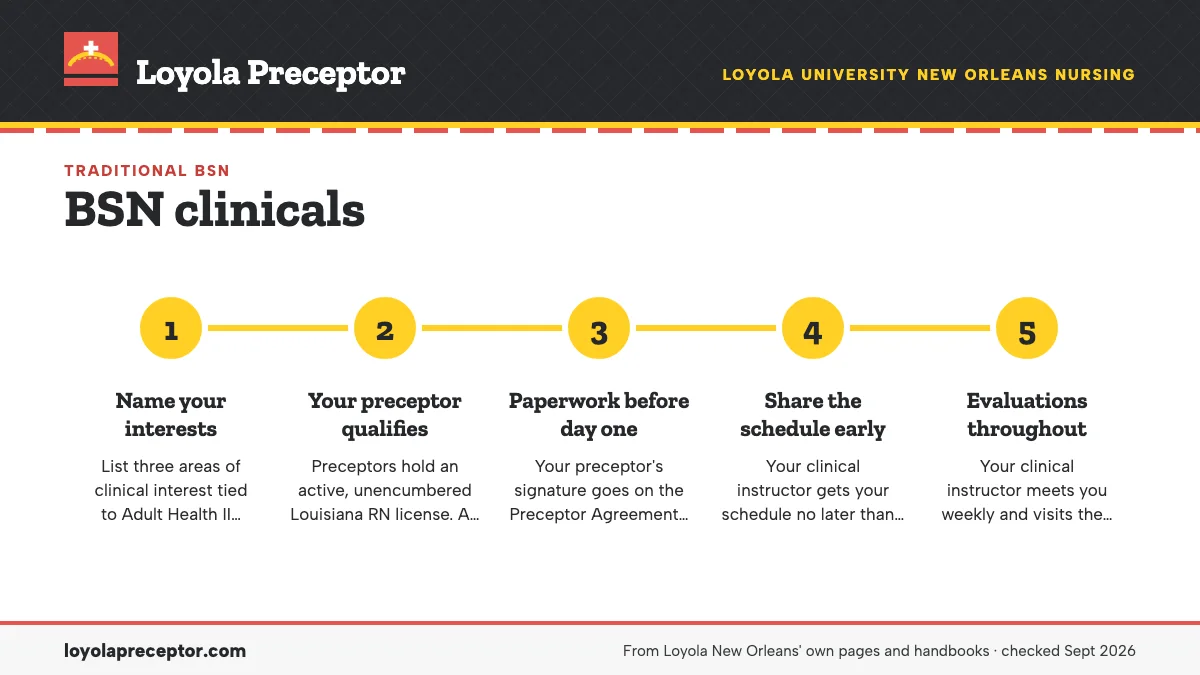
- Name your interestsList three areas of clinical interest tied to Adult Health II. Program faculty choose the final unit, which cannot be one where you work.
- Your preceptor qualifiesPreceptors hold an active, unencumbered Louisiana RN license. A BSN-prepared RN needs at least one year of RN experience in that clinical area; an ASN or diploma RN needs at least three years as an RN, including one year in that area. The preceptor completes the LSBN Preceptor Qualification Form.
- Paperwork before day oneYour preceptor's signature goes on the Preceptor Agreement Form ahead of the first shift; you then post the form in the Canvas course.
- Share the schedule earlyYour clinical instructor gets your schedule no later than four weeks before it begins.
- Evaluations throughoutYour clinical instructor meets you weekly and visits the site in person three times a term: at the beginning, middle and end. The preceptor completes weekly evaluations plus a midterm and a final.
If you come across a graduate practicum guide, note that its upload step differs: graduate students file preceptor agreements in Exxat, while BSN students use the Canvas course.
Simulation before and between rotations
BSN students can use the simulation lab from the first semester of year two. The Loyola Ochsner Nursing Simulation Lab sits on the 5th floor of Monroe Hall, equipped with low- and high-fidelity mannequins, wearable prostheses and birthing simulators. The School of Nursing office is in Bobet Hall.
The lab carries Ochsner's name because of a partnership Loyola announced in 2022 around its undergraduate nursing education. That announcement did not describe graduate NP placements, which is worth knowing if you plan to stay at Loyola for an NP program: the Ochsner placement promise belongs to the BSN.
NCLEX is the exam the BSN leads to. On Loyola's June 2, 2026 disclosure sheet for pre-licensure nursing, every listed state is marked as met except Puerto Rico, which is left undetermined. The School of Nursing State Approvals Map, however, says clinicals cannot be completed in New York, while the BSN table lists New York with no note. The licensure disclosures page puts both side by side.
Where we fit: your graduate program
During the BSN, you are placed. The picture changes in graduate school: Loyola's NP and DNP students choose their own preceptors and practicum sites, from the online MSN FNP and BSN-DNP FNP to the psychiatric and acute care tracks, and each request goes through Exxat Prism three months or more before the term.
Loyola's graduate admission asks for experience first: at least one year of full-time work, and more specific experience for some tracks, such as critical care for the BSN-DNP AGACNP and Nurse Anesthesia, or labor and delivery for Nurse-Midwifery. Use those years to build a network. The FNP guide itself points students to workplace contacts, peers, professional organizations, state NP organizations and community contacts.
When your first graduate practicum approaches, we are the most thorough way to line up a preceptor who fits the Loyola course, in your own area, with the Wishlist details ready and the affiliation agreement question answered early. The BSN-DNP FNP page shows how graduate practicums are sequenced, and finding your own preceptor explains what Loyola asks of graduate students.
Questions Loyola students ask
Does Loyola find clinical placements for BSN students?
Yes. Loyola's BSN page says students receive clinical placements through its partner Ochsner Health, across eight rotations in the last two years. For the 180-hour preceptorship, you name three areas of interest tied to Adult Health II, and program faculty finalize the unit.
How many clinical hours are in Loyola's BSN?
Loyola publishes one BSN hour figure: 180 clinical hours for the undergraduate preceptorship. Hours for the other clinical courses, and their term-by-term order, are not published in the bulletin. Your course syllabi and clinical instructors give the specifics for each rotation.
Do Loyola BSN students need a Louisiana student nursing license?
Yes. The handbook says undergraduates must hold an LSBN student nursing license before any clinical course in Louisiana, which reflects the state board's rule that undergraduates need its approval before enrolling in clinical courses. The application carries its own LSBN background check, separate from the School of Nursing's check.
Can I do my BSN preceptorship on the unit where I work?
No. The Nursing Student Handbook rules out a preceptorship on any unit where you are employed, and program faculty finalize the unit from the three interest areas you name. Graduate practicums follow a separate workplace rule with its own attestation form.
Is there an accelerated option for Loyola's BSN?
Yes. Loyola also offers a hybrid Accelerated BSN for students who already hold a bachelor's in another field: 17 months, full time, with clinicals at partner healthcare organizations in Greater New Orleans. The Accelerated BSN page covers its courses and schedule.
Related pages
Last checked 2026-09-25
We check these pages against Loyola's own bulletin, program pages, practicum guides, forms and licensure disclosures. Your plan of study, your practicum guide, your program director and the Clinical Practicum Coordinator have the final word.
Loyola asks you to select your own preceptor and site. We make that the easy part.
Tell us your Loyola program, where you live and which term your next practicum starts. We find preceptors whose patients fit the course, check whether the site already has a Loyola affiliation agreement, and prepare everything your Exxat Wishlist needs.
- Preceptors matched to the course: outpatient primary care for
NURS G823, pediatrics and obstetrics forNURS G829, acute care forNURS G902, psychiatric care forNURS G856 - Preceptor CV, license and Nursys PDF, the Preceptor Agreement and the site's signer details ready for the Wishlist
- In your own community, in Louisiana or any state where Loyola approves your practicum
Start your placement plan
Program, city and term is all we need to begin.